
Air conditioning repair Melbourne Beach, FL
Melbourne Beach is Brevard's oldest beach community, incorporated as a town in 1923, on the narrowest stretch of the barrier island. Through much of the town the Atlantic and the Indian River Lagoon are only a few hundred yards apart. Seven in ten houses here were standing before 1980: 38 percent predate 1970 and another 32.4 percent went up during the 1970s, giving a median build year of 1974. Owner occupancy is 82.4 percent, the highest of the four beach towns, and 75.4 percent of units are detached houses.
What AC repair Melbourne Beach FL calls turn out to be
Water on both sides of a narrow island
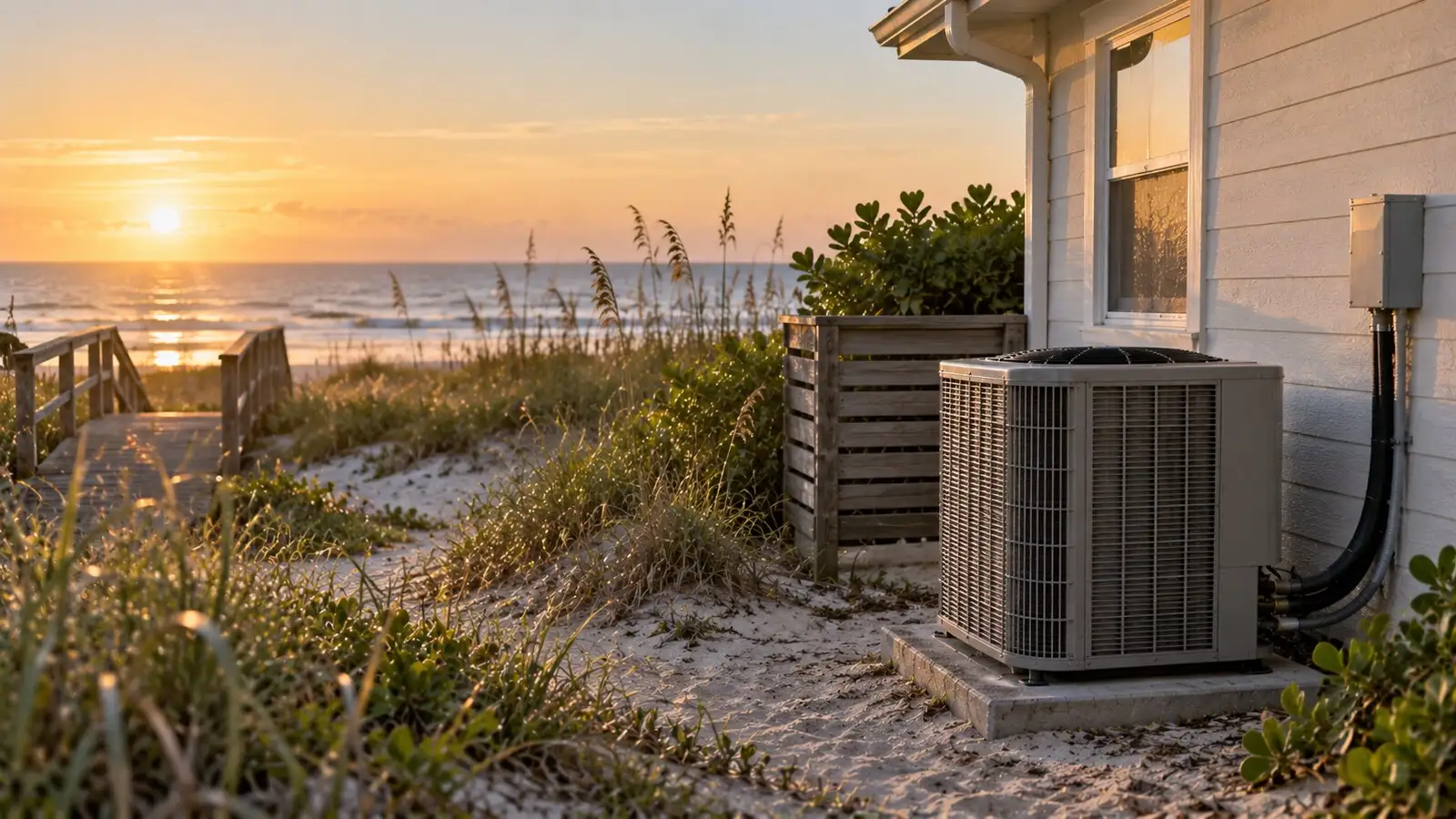
Where the island narrows there is no orientation that escapes salt. An easterly brings ocean aerosol; a westerly brings brackish air off the lagoon a few hundred yards behind the house. Outdoor units in this part of the island receive salt on both faces of the coil rather than on one, and rinsing has to reach the whole fin pack rather than only the side facing the water.
Low attics over 1970s houses
The single-story houses that dominate the town have shallow attics, and the duct threaded into them has limited room to turn. Compressed runs at the eaves, tight radius bends and boots pressed against roof sheathing all restrict airflow, and after fifty years of attic heat the insulation around them contributes little. Static pressure readings on these houses frequently sit well above what the equipment was designed to work against.
Systems that sit idle for months
A share of the housing here is used seasonally, and a system that runs intermittently in a humid climate creates its own problems. Without regular running the house holds moisture, the drain line dries and then blocks with what has grown in it, and the first extended run after a quiet period is when the failures surface. Leaving the system holding a moderate setpoint rather than switching it off entirely is the usual advice.
Distance from the mainland at the wrong moment
Melbourne Beach sits at the south end of the island with a single road running its length, and the nearest crossings to the mainland are north of the town. That matters when a system fails on a Friday afternoon in August, and it matters more when a storm has passed. Scheduling here is more sensitive to timing than it is a few miles north, which is an argument for catching faults at a service visit rather than at failure.
How far Melbourne Beach sits from salt water
Melbourne Beach is about eight tenths of a mile from the Atlantic and under two from the lagoon, and on the narrow southern stretch it is far less than that to both. Every address in town falls inside the coastal specification bands, coated coils and corrosion-resistant hardware are the baseline, and quarterly attention to the outdoor unit is realistic. Units on the ocean-facing side of a house need it more than that.
Band by band: coastal AC corrosion.
Heating and heat pump repair Melbourne Beach, FL
Electricity heats 95.2 percent of homes here and gas is close to absent, so heating means a heat pump running in reverse with strip heat behind it. On a barrier island where the reversing valve has been sitting in salt air since the last cold snap, the classic December call is a system that has stopped reversing and is heating the house entirely on its resistance elements.
Emergency AC repair Melbourne Beach, FL: how a call runs
The combination of age, exposure and a single road along the island means work here rewards planning. Parts availability, roof and side-yard access, and the season all bear on how quickly a failed system can be brought back, and a system inspected in April is a system that is less likely to test any of that in August.
AC installation and HVAC repair Melbourne Beach, FL
- AC Installation & ReplacementSizing, permit, wind anchoring and the R-454B changeover.
- Heat Pump Repair & ServiceReversing valve, strip heat and defrost faults.
- AC Maintenance & Coil CleaningCoil rinse, drain line and airflow, on the right interval.
- Coastal AC CorrosionSalt pitting fins, terminals and cabinet hardware.
Areas covered in Melbourne Beach
Providers cover Melbourne Beach and the surrounding area, including Ocean Avenue, Riverside Drive, Oak Street, the A1A corridor south of town, Avenue A and the Spessard Holland area.
ZIP codes: 32951.
AC repair Melbourne Beach, FL: common questions
- AC not cooling but the fan is still running. What has failed?
- That points outdoors. The indoor blower is on its own circuit and keeps running when the condenser does not, so the usual causes are a failed run capacitor, a contactor that will not close, a high-pressure trip on a fouled coil, or refrigerant that has leaked away. A frozen evaporator gives the same symptom from the other direction. Meters separate them in minutes.
- What happens to an outdoor unit that has been under water?
- Industry guidance from AHRI is that flood-damaged heating and cooling equipment should be replaced rather than repaired. Water reaches electrical components, controls and motor windings, and the damage is not always visible. Insulation that has contacted floodwater is replaced rather than salvaged. Inspection after any submersion belongs to a technician, before the system is energized again.
- Do I need to do anything to the system before a storm?
- Switching the system off at the thermostat and at the outdoor disconnect before a storm protects the compressor from the voltage disturbances that come with outages and restorations. Clearing loose material from around the condenser matters too, since fin packs are easily destroyed by debris. Afterwards, look for water marks and damage before restoring power.
- Why does the house feel humid after we return from a trip?
- Because a system that has been off, or set very high, has not been condensing moisture out of the air, and the building materials have absorbed some of it. Dropping the setpoint sharply on arrival cools the air quickly but gives the coil little running time to dry the house. A moderate setting and longer cycles is what removes moisture.
- Should I switch the system off when the house is empty for a month?
- Generally no. A closed house with the cooling off will climb in humidity, and weeks of that causes problems in materials and finishes. The usual approach is to leave the system at a moderate setpoint, warmer than you would live in but cool enough that it cycles and keeps removing moisture. A drain line checked before you leave matters more than usual.