AC maintenance Melbourne FL: the interval follows the address
Manufacturers describe coastal environments in distances measured from tidal water, and the thresholds are close in: the first thousand feet, the first mile, the first two miles. South Brevard geography turns that gradient into a step. Indialantic and Melbourne Beach sit about eight tenths of a mile from the Atlantic; Satellite Beach and Indian Harbour Beach a mile and a quarter to a mile and a half. Cross the Indian River Lagoon and the nearest mainland is already three to four miles from open water, while western Palm Bay and Viera are eight to ten.
So the honest schedule is not one schedule. Quarterly attention to the outdoor unit under a mile, twice a year in the middle band including Merritt Island and riverfront Rockledge, once a year for the inland cities. Most of the extra visits on the island are short: a rinse of the coil and a look at the electrical compartment, rather than a full inspection every time.
AC tune-up on the outdoor unit
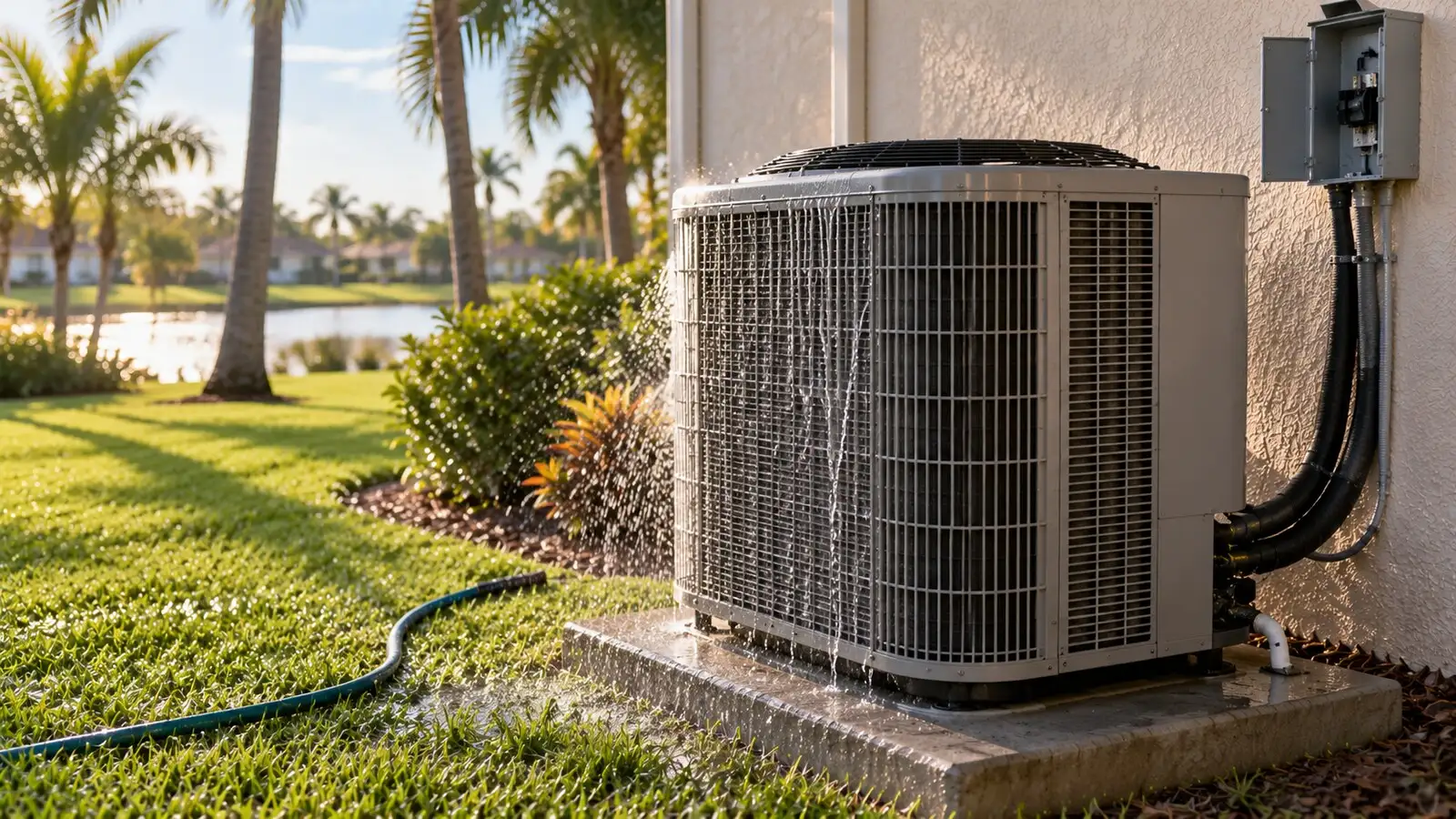
The condenser rejects the heat the system has collected indoors, and it does that through a fin pack that has to stay clean and through air that has to move freely across it. Salt deposit, dust, grass clippings and vegetation growing into the clearance all raise head pressure, which costs capacity on exactly the afternoons capacity is needed and shortens compressor life the rest of the time. Rinsing is done from the inside outward at ordinary hose pressure with the disconnect pulled.
The electrical compartment matters as much as the coil, and on the coast it matters more. Salt film across capacitor terminals and contactor points raises resistance and generates heat, which is how a capacitor that tested acceptably in April fails on a humid August night. The disconnect box and its whip are checked for water intrusion and corroded lugs, because faults there imitate a failing compressor closely enough to get the wrong part replaced.
The indoor side and the drain
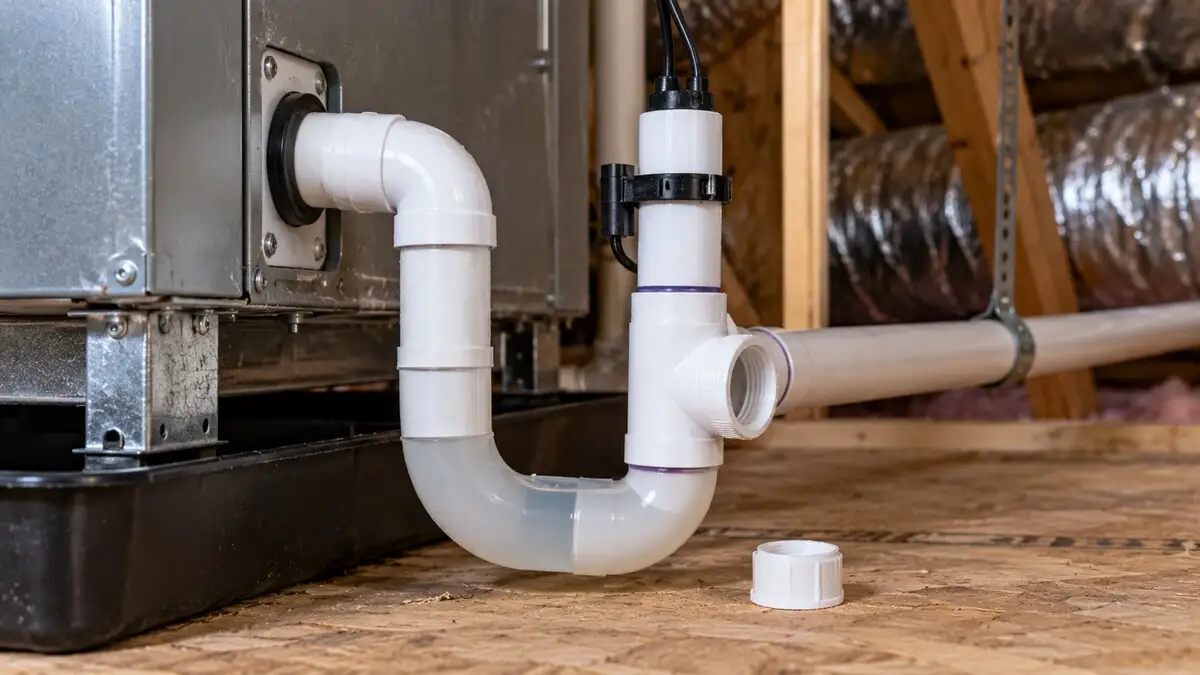
Melbourne records 3,446 cooling degree days a year, which means the evaporator coil is pulling water out of the air on nearly every day of the calendar. That water leaves through a drain line that consequently never dries out, and biological growth in a permanently wet, warm line is the most routine service problem in this county. The line is cleared and treated, the trap checked, the pan inspected, and the float switch tested by lifting it.
The evaporator coil itself is inspected and cleaned. A coil that has been drawing air through a poorly fitted filter accumulates a mat on its upstream face that restricts airflow and holds moisture, which affects both capacity and what the air smells like. The blower wheel collects the same material in its blades, and a loaded wheel moves substantially less air than a clean one at the same speed.
Airflow, and the filter that causes half of it
Static pressure across the air handler is the reading that tells you what the duct and the filter are costing the system, and it is the reading most often skipped. A filter denser than the return grille was designed for is a common and well-intentioned cause of high static pressure: airflow across the coil drops, the coil runs colder than intended, and in the worst case it freezes. The temperature split between return and supply air, measured alongside static pressure, separates a filter problem from a refrigerant problem.
Before and after a storm
The Atlantic hurricane season reaches its climatological peak on 10 September, and the routine around it is straightforward. Before a storm, switch the system off at the thermostat and at the outdoor disconnect, and clear loose material from around the condenser, since fin packs are easily destroyed by debris. Afterwards, look the unit over for water marks and physical damage before restoring power to it.
If the outdoor unit has been submerged, industry guidance from AHRI is that flood-damaged heating and cooling equipment should be replaced rather than repaired, and that duct insulation which has been in contact with floodwater is replaced rather than salvaged because it cannot be reliably decontaminated. Water reaches motor windings, controls and electrical connections, and the damage it leaves is not always visible. Equipment that has stood in water should be inspected before it is energized again.
AC maintenance Melbourne FL and across South Brevard
- AC Maintenance Melbourne
- AC Maintenance Palm Bay
- AC Maintenance West Melbourne
- AC Maintenance Rockledge
- AC Maintenance Merritt Island
- AC Maintenance Satellite Beach
- AC Maintenance Indian Harbour Beach
- AC Maintenance Indialantic
- AC Maintenance Melbourne Beach
- AC Maintenance Viera and Suntree
AC maintenance Melbourne FL: common questions
- How often should the system be serviced here?
- It depends on how far the house is from tidal water. Under a mile from the Atlantic, roughly quarterly attention to the outdoor unit is defensible, most of it a rinse and an inspection of the electrical compartment. In the one to three mile band, twice a year. Further inland, in western Palm Bay, West Melbourne or Viera, once a year covers it. The indoor side, drain line and airflow checks do not need the same frequency and are usually folded into two visits.
- What is actually done on a maintenance visit?
- Outdoors: rinse the condenser coil, inspect the fin pack for pitting and damage, check the capacitor against its rating, inspect contactor points, check fan motor amp draw and mounting, and look inside the disconnect. Indoors: inspect and clean the evaporator coil, check the blower wheel, clear and treat the condensate drain, test the float switch, replace or fit the filter correctly, and measure static pressure and temperature split. Then the refrigerant charge is verified by superheat or subcooling.
- Can I clean the outdoor coil myself?
- You can rinse the outside of it with a garden hose at ordinary pressure, working from inside the fin pack outward so deposits are pushed out rather than driven deeper, with the disconnect pulled first so nothing is energized. What you should not do is use a pressure washer, which folds fin material flat and does more damage than the salt it was meant to remove. Anything involving the electrical compartment is a technician's work.
- Does maintenance affect the warranty?
- It can decide it. Manufacturer parts warranties generally require registration within a set window after installation to reach their full term, and they commonly exclude failures arising from lack of maintenance or from installation faults. A compressor that failed on a coil nobody had cleaned in six years is exactly the claim that gets questioned. Keeping dated service records is what turns a warranty claim into paperwork rather than an argument.
- Why does the drain line block so often in Florida?
- Because the coil is condensing water almost every day of the year. Melbourne records 3,446 cooling degree days annually, so the drain line stays permanently wet and warm, which is an ideal environment for biological growth. That growth eventually restricts the line, the pan fills, and the float switch shuts the system down, which is the switch doing its job. A dry, unused drain line during a long absence blocks for the opposite reason.